Bhandari Shikshan Parishad, Goa (1926)
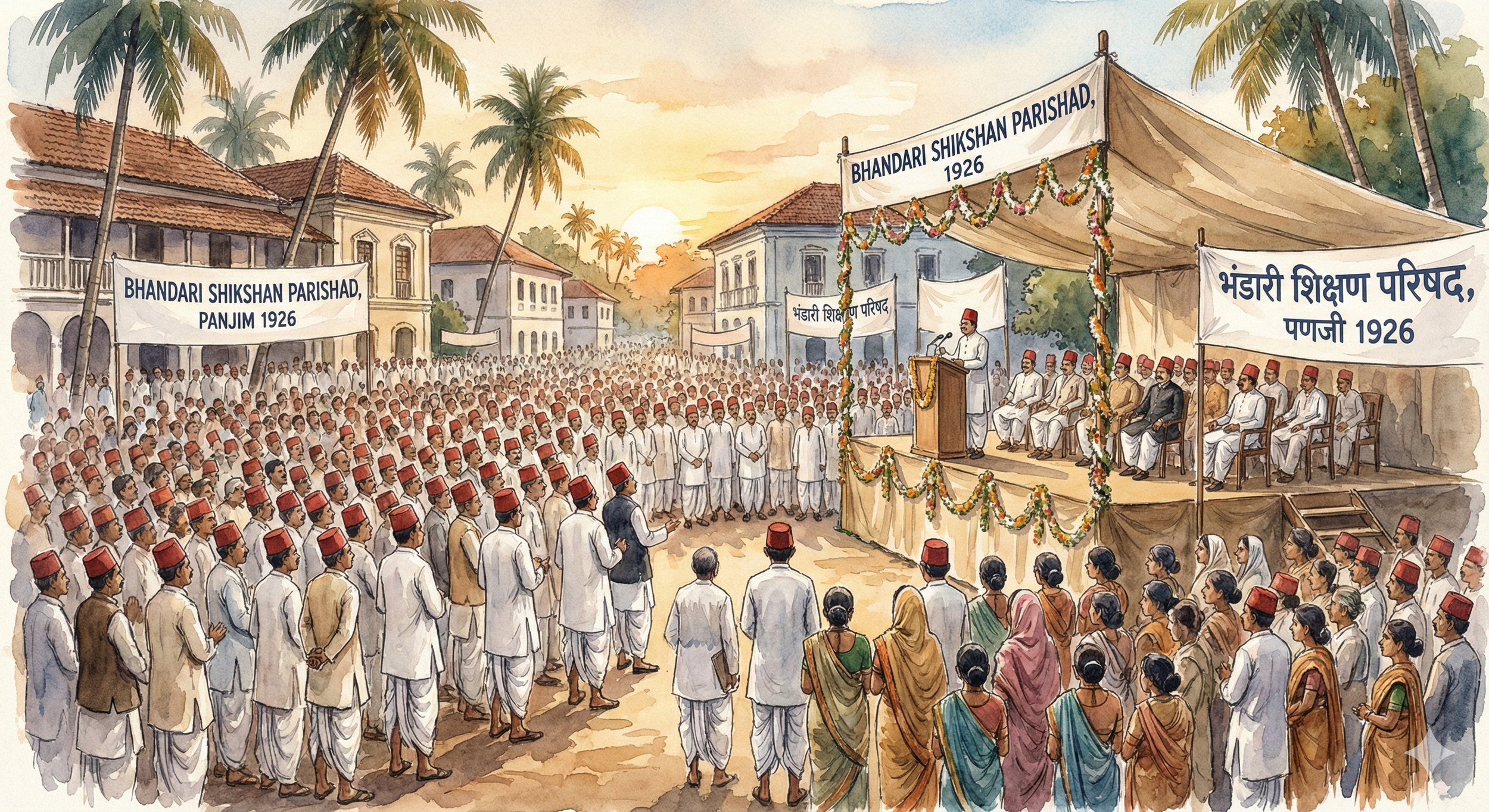
On December 26, 1926, the streets of Panjim witnessed a spectacle unlike any other. It was not a religious festival, nor a colonial parade, but a march of dignity. Thousands of members of the Bhandari community, many of whom had traveled by foot and ferry gathered in the capital for the 13th Bhandari Shikshan Parishad. This event was not merely a meeting; it was a watershed moment that marked the transition of the Bhandari Samaj from a disjointed agrarian workforce into a unified, socio-political force in Goa.
By the 1920s, the Bhandari community—despite being the numerical majority in Goa—remained on the fringes of power. Relegated to traditional occupations of toddy tapping, farming, and soldiery, they faced systemic exclusion from the Portuguese administration and the upper-caste dominated social hierarchy. While the formation of the Gomantak Kshatriya Bhandari Samaj in 1913 had lit a spark, it was the 1926 conference that fanned it into a flame. The objective was singular and radical: to shift the community's destiny from labor to literacy.
Under the presidency of Bablo Marto Naik, the conference adopted resolutions that would shape the next century, arguing that as long as the Bhandari youth remained uneducated, they would remain subservient. The mandate of the conference was immediate and far-reaching. It directly inspired the creation of community-run schools, such as the Ramdas School in St. Inez, to bypass discriminatory admission policies in elite institutions. Furthermore, it called for the abandonment of regressive social habits and internal caste sub-divisions that weakened the collective. Today, the 13th Bhandari Shikshan Parishad is remembered as the "Great Awakening" of the Bahujan masses in Goa—the day the community realized that their hands, which were strong enough to till the land and build bridges, were also capable of holding pens and shaping policy.